City Block Builder
City Block Builder
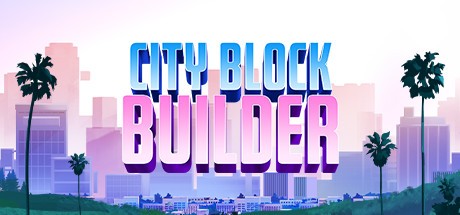
Project
City Block Builder
Duration
1 year
Role
Lead Designer & Manager
Revenue
Not Successful
Company size
20+
Overview & Concept
Overview & Concept
Developer/Publisher: Tentworks Interactive
Release: Early Access on August 17, 2022
Genre: Tycoon / City‑builder / Management / Simulation set in 1950s Los Angeles
Core idea: Players assemble and grow a block of businesses—restaurants, cinemas, jazz clubs, etc.—balancing micro-operations (staff, décor, foot traffic) with macro goals (research upgrades, expansion)
Target Audience
City-builder / management fans who enjoyed classic tycoons
Indie gamers drawn by niche historical setting (1950s LA)
Early access contributors: players intrigued by development-stage potential
Developer/Publisher: Tentworks Interactive
Release: Early Access on August 17, 2022
Genre: Tycoon / City‑builder / Management / Simulation set in 1950s Los Angeles
Core idea: Players assemble and grow a block of businesses—restaurants, cinemas, jazz clubs, etc.—balancing micro-operations (staff, décor, foot traffic) with macro goals (research upgrades, expansion)
Target Audience
City-builder / management fans who enjoyed classic tycoons
Indie gamers drawn by niche historical setting (1950s LA)
Early access contributors: players intrigued by development-stage potential
Player Needs & Problem Solving
Player Needs & Problem Solving
City Block Builder is designed to meet three core player needs:
1. Creative Expression
Players want the freedom to design and customize their city block—placing buildings like restaurants, cinemas, or clubs, and decorating interiors with furniture, lighting, and props. The game offers a sandbox mode that supports this creativity, giving full control over layouts and aesthetics.
2. Strategic Thinking
Beyond decoration, players are challenged to manage their businesses strategically. This includes:
Hiring and assigning staff
Managing budgets and finances
Unlocking and investing in research
Analyzing foot traffic and customer behavior
This satisfies players who enjoy simulation and optimization, not just casual building.
3. Progression & Expansion
Players are motivated by the goal of growing from one small business into a full city block. The game introduces research trees and unlockable businesses, which appeal to users seeking long-term progression and rewards for smart planning.
In short, City Block Builder aims to solve the common need for:
Freedom + control (creative sandbox)
Challenge + reward (deep management systems)
Growth + ambition (expanding your empire)
City Block Builder is designed to meet three core player needs:
1. Creative Expression
Players want the freedom to design and customize their city block—placing buildings like restaurants, cinemas, or clubs, and decorating interiors with furniture, lighting, and props. The game offers a sandbox mode that supports this creativity, giving full control over layouts and aesthetics.
2. Strategic Thinking
Beyond decoration, players are challenged to manage their businesses strategically. This includes:
Hiring and assigning staff
Managing budgets and finances
Unlocking and investing in research
Analyzing foot traffic and customer behavior
This satisfies players who enjoy simulation and optimization, not just casual building.
3. Progression & Expansion
Players are motivated by the goal of growing from one small business into a full city block. The game introduces research trees and unlockable businesses, which appeal to users seeking long-term progression and rewards for smart planning.
In short, City Block Builder aims to solve the common need for:
Freedom + control (creative sandbox)
Challenge + reward (deep management systems)
Growth + ambition (expanding your empire)
UX & Visual Design
UX & Visual Design
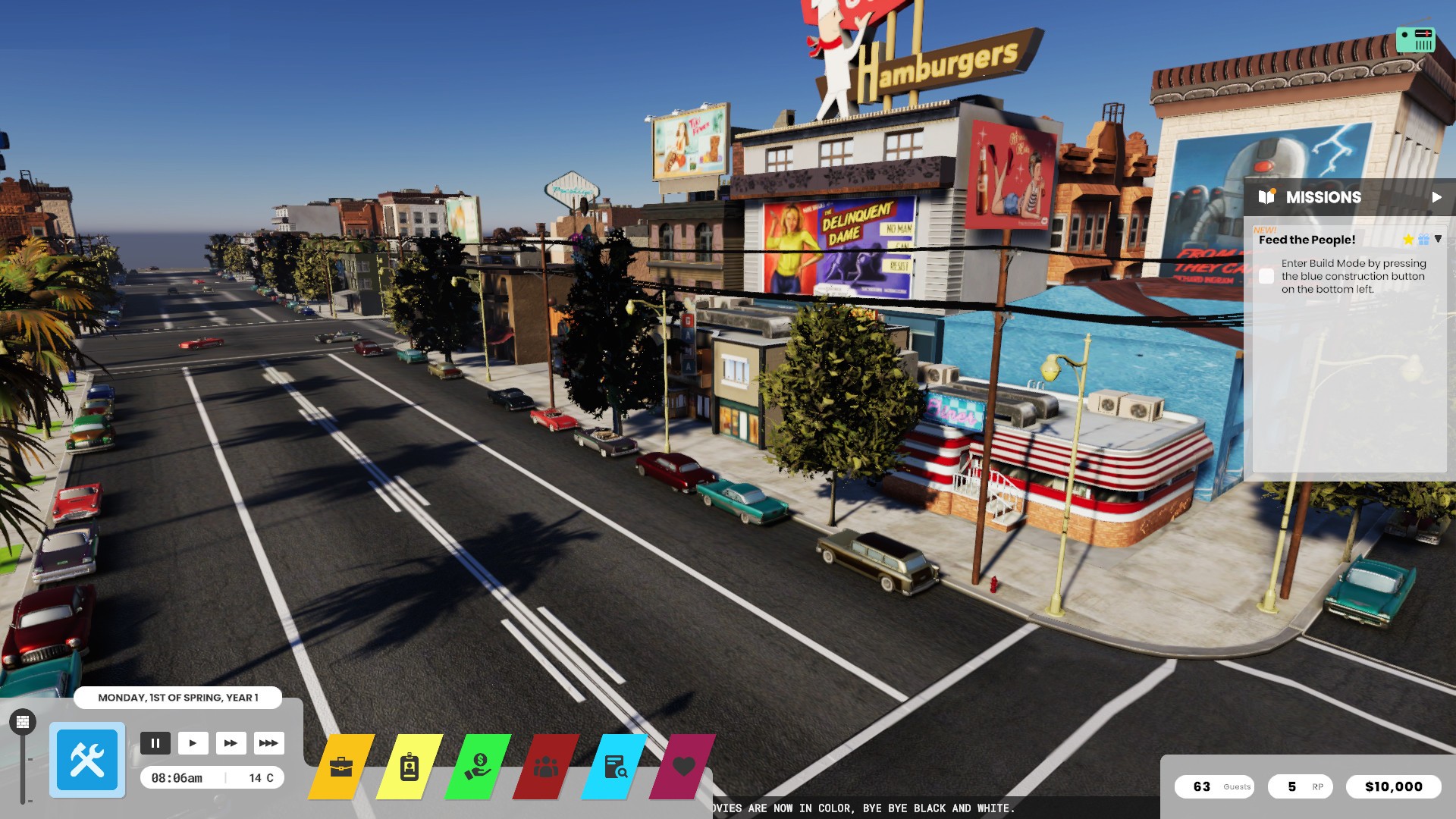
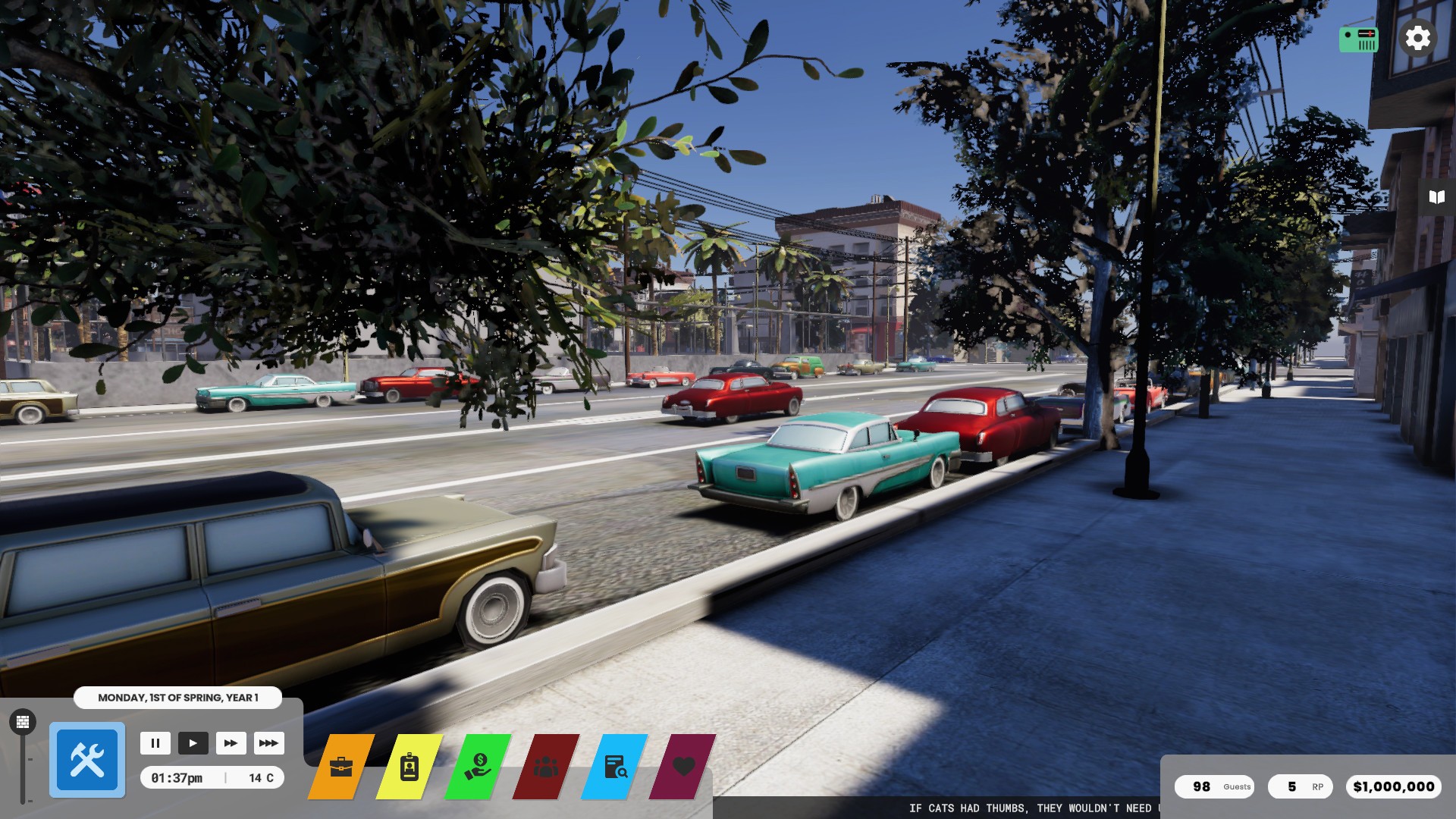
City Block Builder uses a 3D visual style with a retro 1950s aesthetic, reflecting the post-war American city vibe—bright signage, vintage architecture, and neon lighting.
Visual Design
Art Style: Semi-realistic cartoonish graphics, inspired by mid-century Americana.
Environment: Buildings, roads, trees, and characters are modeled in a stylized but detailed way, giving it a warm and nostalgic look.
Color Palette: Uses muted tones with pops of color to give the impression of a vibrant but lived-in block.
User Experience (UX)
Building System: Players can drag and drop structures like cinemas or restaurants into place. Layout adjustments (like rearranging furniture or hiring staff) are done through on-screen panels.
UI Elements: There are panels for:
Budget & income tracking
Staff management
Research trees (for unlocking new business types)
Feedback: Players receive visual and numeric feedback for profits, crowd density, and popularity.
UX Pain Points Reported by Users
Some buttons were unresponsive during gameplay.
Menus and UI panels reportedly overlap or become unreadable when resized.
Lack of onboarding: New players feel lost due to minimal tutorials or guidance.
Zoom & camera controls: Some reviews mention that zooming in/out or rotating the view can be unintuitive.
Summary:
While the game’s visual design is charming and well-themed for the 1950s setting, its user interface and interaction design need improvement—especially in responsiveness, layout clarity, and helping new users get started.
City Block Builder uses a 3D visual style with a retro 1950s aesthetic, reflecting the post-war American city vibe—bright signage, vintage architecture, and neon lighting.
Visual Design
Art Style: Semi-realistic cartoonish graphics, inspired by mid-century Americana.
Environment: Buildings, roads, trees, and characters are modeled in a stylized but detailed way, giving it a warm and nostalgic look.
Color Palette: Uses muted tones with pops of color to give the impression of a vibrant but lived-in block.
User Experience (UX)
Building System: Players can drag and drop structures like cinemas or restaurants into place. Layout adjustments (like rearranging furniture or hiring staff) are done through on-screen panels.
UI Elements: There are panels for:
Budget & income tracking
Staff management
Research trees (for unlocking new business types)
Feedback: Players receive visual and numeric feedback for profits, crowd density, and popularity.
UX Pain Points Reported by Users
Some buttons were unresponsive during gameplay.
Menus and UI panels reportedly overlap or become unreadable when resized.
Lack of onboarding: New players feel lost due to minimal tutorials or guidance.
Zoom & camera controls: Some reviews mention that zooming in/out or rotating the view can be unintuitive.
Summary:
While the game’s visual design is charming and well-themed for the 1950s setting, its user interface and interaction design need improvement—especially in responsiveness, layout clarity, and helping new users get started.
Game Mechanics – Explained
Game Mechanics – Explained
City Block Builder combines micro- and macro-management mechanics to give players a detailed business simulation experience. Here’s a breakdown:
1. Micro-management
Players are involved in managing individual businesses (e.g., restaurants, cinemas). This includes:
Hiring staff: Cooks, cashiers, janitors, etc.
Customizing interiors: Choosing furniture, decor, and lighting to influence customer satisfaction.
Setting prices: Adjusting menu prices or ticket rates to balance profits and appeal.
Goal: Maximize individual business performance.
2. Macro-management
Beyond managing single stores, players oversee the entire city block:
Research system: Unlock new businesses (like arcades or jazz clubs) and upgrades via a research tree.
Financial strategy: Allocate budget across businesses, R&D, and infrastructure improvements.
Urban layout: Decide building placement to optimize customer flow and space usage.
Goal: Grow your block into a bustling, profitable entertainment district.
3. AI Crowd Simulation
The game simulates realistic customer behavior:
People wander into businesses, respond to layout efficiency, and react to service quality.
Poor layout or long wait times affect satisfaction and revenue.
This system adds life and challenge to managing operations.
4. Progression System
You start with small businesses and limited space. As you succeed:
You unlock larger plots, advanced facilities, and staff upgrades.
The complexity scales with your success, offering long-term engagement.
Summary
City Block Builder’s gameplay loop is a mix of:
Building and customizing businesses
Managing staff and services
Monitoring customer behavior
Expanding the block using strategic planning
This layered system provides both tactical and creative satisfaction for tycoon game players.
City Block Builder combines micro- and macro-management mechanics to give players a detailed business simulation experience. Here’s a breakdown:
1. Micro-management
Players are involved in managing individual businesses (e.g., restaurants, cinemas). This includes:
Hiring staff: Cooks, cashiers, janitors, etc.
Customizing interiors: Choosing furniture, decor, and lighting to influence customer satisfaction.
Setting prices: Adjusting menu prices or ticket rates to balance profits and appeal.
Goal: Maximize individual business performance.
2. Macro-management
Beyond managing single stores, players oversee the entire city block:
Research system: Unlock new businesses (like arcades or jazz clubs) and upgrades via a research tree.
Financial strategy: Allocate budget across businesses, R&D, and infrastructure improvements.
Urban layout: Decide building placement to optimize customer flow and space usage.
Goal: Grow your block into a bustling, profitable entertainment district.
3. AI Crowd Simulation
The game simulates realistic customer behavior:
People wander into businesses, respond to layout efficiency, and react to service quality.
Poor layout or long wait times affect satisfaction and revenue.
This system adds life and challenge to managing operations.
4. Progression System
You start with small businesses and limited space. As you succeed:
You unlock larger plots, advanced facilities, and staff upgrades.
The complexity scales with your success, offering long-term engagement.
Summary
City Block Builder’s gameplay loop is a mix of:
Building and customizing businesses
Managing staff and services
Monitoring customer behavior
Expanding the block using strategic planning
This layered system provides both tactical and creative satisfaction for tycoon game players.
Conclusion
Conclusion
City Block Builder started with a promising concept—offering players a nostalgic 1950s city-building experience with rich micro-management and creative freedom. The game’s AI simulation, detailed customization, and layered progression systems had the potential to stand out in the tycoon genre.
However, despite its unique setting and early buzz, the game struggled to maintain momentum. Delayed updates, technical issues, and limited content left many players disappointed. As a result, it failed to generate significant revenue or build a strong, active player base.
Unless development resumes and key issues are addressed, City Block Builder risks remaining an ambitious idea that never fully materialized into a commercially successful product.
City Block Builder started with a promising concept—offering players a nostalgic 1950s city-building experience with rich micro-management and creative freedom. The game’s AI simulation, detailed customization, and layered progression systems had the potential to stand out in the tycoon genre.
However, despite its unique setting and early buzz, the game struggled to maintain momentum. Delayed updates, technical issues, and limited content left many players disappointed. As a result, it failed to generate significant revenue or build a strong, active player base.
Unless development resumes and key issues are addressed, City Block Builder risks remaining an ambitious idea that never fully materialized into a commercially successful product.